

Study Design in the Age of AI
The emergence of AI is believed to be as equally powerful as other transformative technologies such as internal combustion engines, personal computers, and the internet. We are only at the start of this digital age and seeing the convergence of technologies transforming the way we live and work. The use of AI tools from image editors to image generators has saved time and simplified the process of creating mood boards, generating ideas, creating rapid prototypes and many other applications.
AI does not replace designers nor does it undermine the basic principles and approach of design thinking, which emphasises solving complex problems through developing an understanding of the users and their environments, according to a Working Paper published by Harvard Business School. Rather, it helps to overcome past limitations of human-intense design processes. In other words, AI can augment designers’ workflows to be faster and better. For instance, AI uses sketches or text prompts and conjures up different versions of images that can be used for mood boards in no time.
The use of AI tools shifts the demand to design services that require more valuable meta-skills such as empathy and research, working in multi-disciplinary teams, identifying and framing problems to solve, and learning new skills. These skills could be picked up at work, or are taught more systematically at the Master’s level.
In the age of AI where innovation takes place, designers are becoming more crucial when they collaborate with AI in the design process.
In this context, the Master of Design (MDes) programmes at the Hong Kong Polytechnic University (PolyU) is uniquely positioned to support this emerging area of design. PolyU’s MDes, first launched in 2004, is well established and was recognised as one of the best in the world. Aiming to develop proactive leaders and game changers for the future of industries, the MDes launched a restructured curriculum recently. Four specialisations with differing educational opportunities are offered:
- Innovative Business Design (IBD)
- Intelligent Systems Design (ISD)
- Smart Service Design (SSD)
- Transitional Environments Design (TED)
Organised under a scheme, the above MDes programmes are characterised by:
- Interdisciplinarity: Underpinning the MDes is interdisciplinary research and education. Students work with interdisciplinary teams on projects delivering practical and conceptual outcomes.
- Research-based studies and projects: Our studies provide students with an opportunity to be involved in real-world research projects, access the lab equipment, and get closer contact with more
established and experienced researchers in the field. - High-level flexibility and variety: Our choice of electives makes planning studies and exploring different interests easy. Students can change their specialisation during and their graduation award title completing their studies.
Students are expected to be equipped with professional and academic knowledge skills as well as generic skills for all-roundedness. The latter, such as critical and creative thinking, awareness of current and emerging issues, communication, multidisciplinary project management and multicultural competence, are many of the more valuable meta-skills that define the roles of designers in the age of AI.
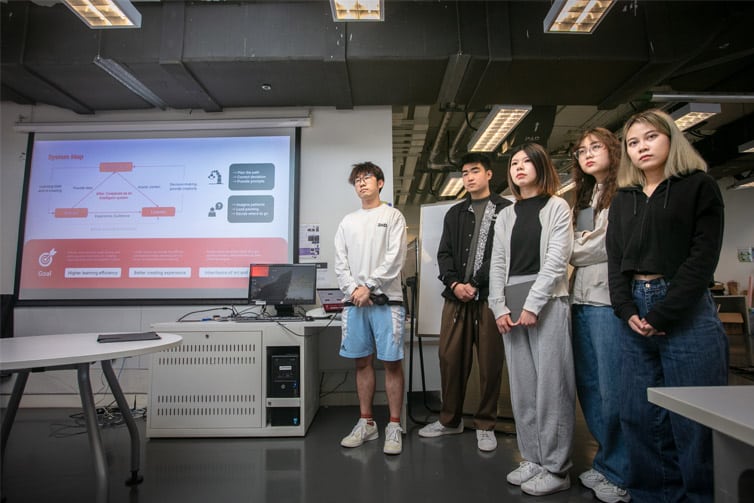
The multidisciplinary group of ISD students developed a creative design vision to revitalise Chinese cultural heritage and built an intelligent system using AI and robotics to realise the inheritance of traditional skills in sugar paintings.
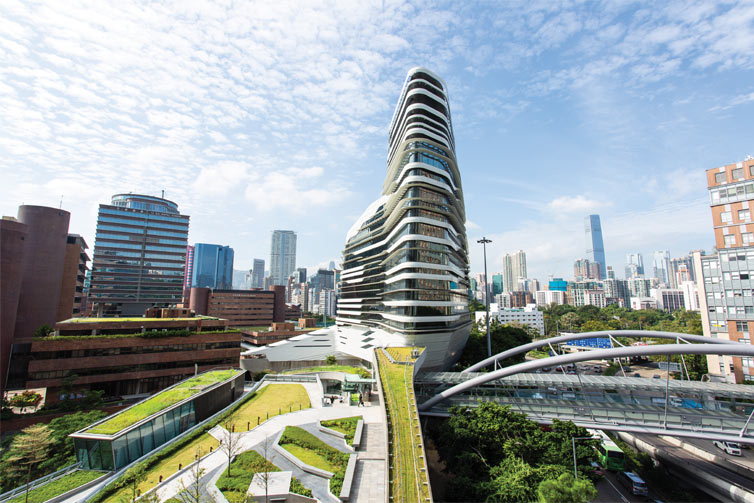
PolyU Design has been an important hub of design education and research for Hong Kong since 1964. The School is ranked among 20 global top schools on the QS Art and Design Rankings. Academic programmes are offered at bachelor, master, and doctoral levels in highly diverse design expertise.
The use of AI tools shifts demand to design services that require more valuable meta-skills which could be picked up at work or are taught more systematically at the Master’s level.